Or: Why I stopped arguing with strangers on the internet and started enjoying my mornings again.
Welcome to the club nobody wanted to join
If you sell digital art online, congratulations — you have officially joined the world's most exclusive support group. The membership perks include unsolicited critique from strangers, philosophical lectures from people who couldn't draw a stick figure, and the occasional death threat over your shoulder while you're trying to enjoy your morning coffee.
I have been designing characters in Photoshop for fifteen years. In that time, I have learned that the messages flooding our inboxes are not as random as they seem. After enough years, you start to notice a pattern. The trolls who think they are uniquely clever, devastating, and original are actually following one of four well-worn scripts. Once you can recognize the script, the curtain falls and the magic disappears.
This post is for fellow digital creators who are tired of explaining themselves to people who were never really asking a question.
Let me introduce you to the cast.
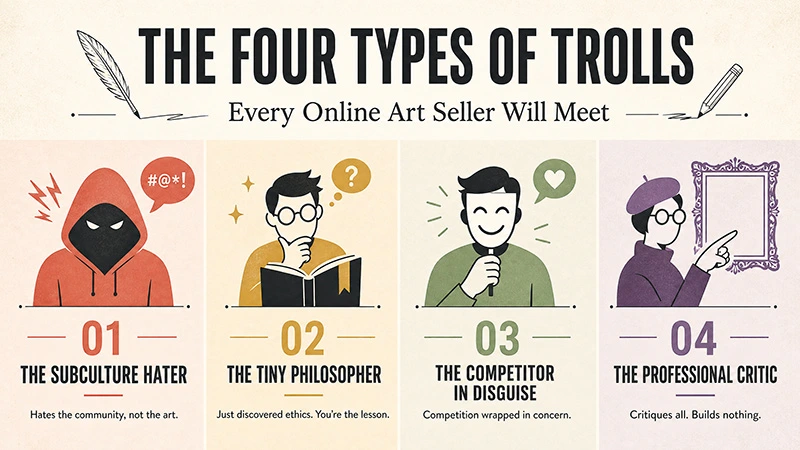
The Four Types of Trolls
Type 1: The Subculture Haters
These are the people who do not have a problem with you — they have a problem with the entire community you serve. They have decided, somewhere deep in the toxic corners of the internet, that your customers are subhuman and therefore so are you.
They will not engage with your art. They will not look at your prices. They will not consider whether your design is good. They will simply find your shop, locate the angriest possible feeling inside themselves, and send it your way.
I have personally received explicit threats on my life through Etsy messages — including very creative descriptions of what they would do to me if they ever found me. This is not a metaphor. This is just Tuesday.
The pattern: Threats, slurs, violent imagery, references to your community as a whole rather than your work specifically.
What they want: To make you quit. To make the entire community quit. To feel powerful for thirty seconds in a life that probably contains very little actual power.
What they hate hearing: Nothing you say. Truly nothing. There is no clever response, no perfect comeback, no logical argument that will land. Engaging with them is feeding a stray cat — they will come back tomorrow, and now they have brought friends.
Type 2: The Tiny Philosophers
These are usually teenagers or very young adults who have recently discovered that morality exists, and they are extremely excited to tell everyone about it. They believe they have figured out something profound — usually around midnight, possibly after watching one YouTube essay — and they have selected you to receive this revelation.
Their messages tend to begin with words like "actually" or "have you considered" or "as someone who genuinely cares about art..." — sentences that translate roughly to "I am about to be exhausting."
The pattern: Lengthy lectures, moral high ground, philosophical questions that are actually accusations dressed in question marks, casual references to ethics they invented an hour ago.
What they want: To be taken seriously. To feel like an intellectual. To be the protagonist of their own ethics seminar in which you play the cautionary tale.
What they hate hearing: Brief, polite responses that do not engage with their thesis. They are hoping for an argument that proves them important. A two-sentence reply followed by silence is their worst nightmare.
The good news: most of them will grow out of this phase within a few years. The better news: you are not their parent and it is not your job to accelerate that process.
Type 3: The Competitor in Disguise
This one is sneaky. They show up as concerned colleagues, fellow artists, or "someone who has been in this industry a long time." Their messages are polite, even friendly, but somewhere in there is a sentence designed to make you feel small.
"I noticed your prices are quite low — are you sure you are valuing your work?"
"Just so you know, the way you are doing things is going to hurt the industry."
"I have been doing this for years, and I just want to give you some friendly advice..."
What is actually happening: you have moved into their corner of the market. Your SEO is working. Your designs are selling. Your shop is visible. They are not worried about the industry — they are worried about their slice of it, and the easiest path forward (for them) is to make you doubt yourself instead of improving their own work.
The pattern: Unsolicited advice wrapped in concern, vague references to "the community" or "the industry," suggestions that you are doing harm by simply existing in a way that competes with them.
What they want: For you to slow down, second-guess yourself, raise your prices uncomfortably, change your style, or quietly disappear.
What they hate hearing: "Thanks for the feedback!" and nothing else. No engagement. No defense. No long explanation of your business choices. They wanted you to argue or comply — a polite non-response is the one outcome they did not prepare for.
Type 4: The Professional Critic Who Never Created Anything
This is my personal favorite, if only because the irony writes itself.
These are the people who spend hours scrolling through digital art shops for the sole purpose of finding things to complain about. They have opinions about everything — your linework, your color choices, your composition, your pricing, your existence as a small business owner.
Here is the tell: ask them where their portfolio is. Ask them what they have made. Ask them where their shop is.
Silence.
Their entire body of creative work consists of comments left under other people's creative work. They have built nothing, sold nothing, risked nothing — but they have a lot to say about people who do.
The pattern: Detailed critique with no constructive intent, comparisons to "real artists" they cannot name, vague references to "standards" they themselves do not meet.
What they want: To feel like an authority. To borrow your accomplishments by tearing them down. To exist creatively without ever doing the terrifying work of creating something.
What they hate hearing: Genuine curiosity. "That is interesting — could you send me a link to your work so I can see the standard you are referencing?" They will not respond. They cannot respond. The trap is too elegant to escape.
The Pattern That Unites Them
Notice anything?
All four types share a single defining trait: none of them are building anything.
The subculture hater is not creating a community — they are trying to destroy one. The tiny philosopher is not making art — they are critiquing it. The competitor in disguise is not improving their own shop — they are trying to slow yours down. The professional critic is not producing work — they are commenting on other people's.
Your shop exists because you took the risk of putting your work into the world. Their messages exist because they did not.
That is not a coincidence. That is the whole story.
The Survival Strategy
Now for the practical part. After fifteen years in this industry, here is what I have learned actually works.
Block without guilt. Etsy gives you a block button. It is not reserved for emergencies. You do not owe anyone the right to send you messages. Someone makes your day worse? They lose access to you. The end. There is no committee that meets to decide whether the block was justified. You are the committee. The vote is unanimous.
Stop reading past the first red flag. If a message opens with "actually," "you should know," "as a fellow artist..." — you already know how the rest of it goes. Save your eyes, save your morning, and archive it. The contents of that message are not going to change your life. The five minutes you spend reading it will.
Build a template library. Most of these messages fall into predictable categories, which means your responses can too. Write a polite, neutral reply once, save it, and reuse it forever. A short professional response sent in fifteen seconds protects your energy and ends the conversation. Long, thoughtful, emotional responses invite long, thoughtful, emotional follow-ups.
Tighten your message settings. Most platforms let you restrict who can message you. Verified buyers only, follower-only DMs, filtered keywords — use what your platform offers. Every filter you put up is a wall between you and someone whose entire life purpose is to ruin your Tuesday.
Do not defend yourself in public. This one is hard. When someone criticizes you publicly, the instinct is to respond, explain, set the record straight. Resist. Public defenses feed the algorithm of conflict, attract more critics, and waste your most valuable resource — the time you would otherwise spend creating. Quiet success is the best response. The shop keeps running. The orders keep arriving. The trolls keep tweeting into the void.
Remember who is actually watching. For every loud critic in your inbox, there are hundreds of quiet customers enjoying their purchase. The math is not even close. You are not in business for the people who write angry messages — you are in business for the people who never feel the need to.
A Final Word
If you are a digital creator just starting out — selling on Etsy, Gumroad, Patreon, anywhere — and you are getting your first taste of unsolicited internet attention, I want you to know two things.
First: it never fully stops. The trolls do not get bored and move on. They are an occupational hazard, like back pain for hairdressers or coffee dependency for graphic designers.
Second: it gets infinitely easier. Not because the trolls change, but because you do. You stop reading their messages with your whole heart. You start recognizing the scripts. You develop the muscle memory of block, archive, move on. Eventually, you reach a place where their attempts to ruin your morning bounce off you completely, and you go back to doing the thing they could never do — making something real.
Build the shop. Make the art. Ship the orders. Block the trolls.
The internet has plenty of angry people with sharpened pencils. The world needs more people who actually use theirs.